 Wed 8/5/26 – 4-9 PM – Unflavored or flavored? We each have our preferences or do we know what the taste differences are? Compare a 1 oz pour of apricot-flavored brandy and a 1 oz pour of its apricot distilled spirit; or try the peach-flavored brandy and its peach distilled spirit. Let’s get educated on this important subject!
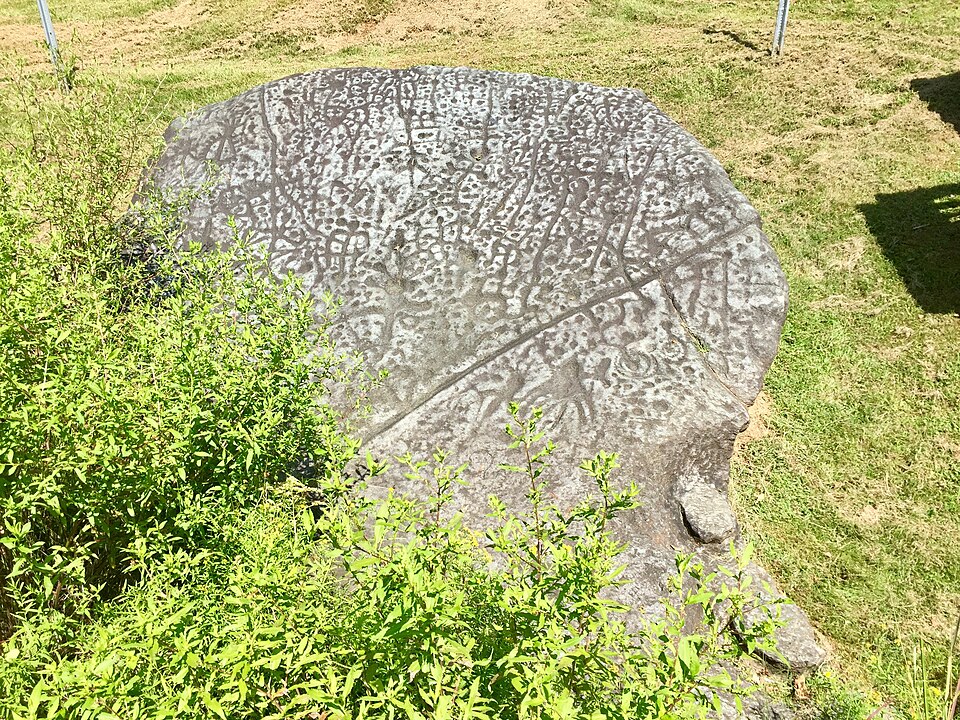 Thurs 8/6/26 – 4-9 PM – Judaculla Cocktail Specials -Located in Cullowhee, Western North Carolina, is a curvilinear-shaped outcrop of soapstone known for its ancient carvings and petroglyphs known as Judaculla Rock. It contains more petroglyphs than any other known boulder east of the Mississippi River. It contains approximately 1,548 motifs, which is 3.7 times the total of 421 motifs at the next substantial Track Rock Gap petroglyph complex in northern Georgia. Listed on the National Register of Historic Places, the archaeological site is located on a 0.85-acre rectangular-shaped property, now owned by Jackson County. Previously cultivated as a cornfield, it is now covered with mowed turf grass and bordered by a thicket of rivercane. Measuring 240 square feet, the stone’s surface is covered with petroglyphs and scars from soapstone bowl diggings to make pipes and other utensils for everyday use by the Native American Cherokees. This type of soapstone quarrying began in the Late Archaic period (250 BC – 500 AD), roughly 3,500 years ago. More recent stylized figurative motifs probably date to somewhere between the Middle Woodland to Late Mississippian periods, about 500 A.D. to 1700 A.D., perhaps even into the early historic period (late 1700s).
Numerous petroglyphs have been pecked and incised into the surface resulting in densely packed motifs, especially those along the upper two-thirds of the boulder. This makes it difficult to distinguish between the carvings but a minimum count of the patterns reveals 1,458 cup marks, 47 curvilinear units, 10 bowl-shaped depressions, 10 stick-like figures, 9 rills, 3 concentric ring designs, 3 curvilinear motifs, 3 deer tracks, 3 claw-like imprints, 1 arc, 1 cross-in-circle, and 1-winged shape.
Although the majority of the Cherokee people were forcibly removed to Indian Territory in 1838, both tribes in Oklahoma and North Carolina continued to teach their oral history and Judaculla Rock retained a special significance for them. Cherokee accounts link Judaculla known in Cherokee as Tuli-cula/Juthcullah/Tsul ‘Kalu which translates to “slant-eyed Master-of-Games and connect it with surrounding landscapes, including landforms, rivers and Cherokee towns. It is also located on an old trail that linked the former Cherokee townhouse at Cullowhee (Juthcullah’s Place) with Tanasee Bald (Tsunegûñyĭ). Also in Cherokee tradition, the rock’s markings are explained as the imprint left when Judaculla, leaping from his mountaintop to drive off trespassing hunters, landed with his hand on the then-soft stone and scratched it with his fingernail. Until the Cherokee removal of 1838, priests and hunters are said to have visited the rock to leave offerings and petition him for success in the hunt. The Cherokee educator Tom Belt has described Judaculla Rock as a kind of “text” or “manuscript” that grounds Cherokee identity and teaches how to care for the land. Judaculla Cocktails – Judaculla Cocktail – CB Frost, gin, St. Germain, simple syrup, lemon juice, muddled grapes; Cullowhee Cocktail – CB Frost, orange juice, cranberry juice, lime; Tanasee Bald – CB Frost, Marionberry brandy, lime juice, ginger beer; 1/2 price US Flight.
Wed 8/12/26 – 7-9 PM – NC Writers Network West features two guest authors in its series “In the Company of Writers” with authors Bruce Spang and Ginger Graziano. Hope you can join us!